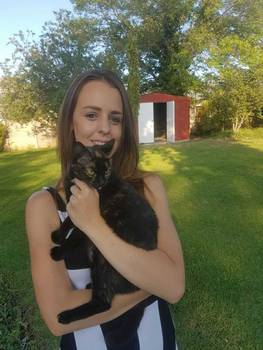
Written by Kayleigh-Jean Legge
In the home of a vet and a vet student, it’s not uncommon to be awoken at an ungodly hour by some form of animal-related crisis. But there was something different about this night…
Something wasn’t right
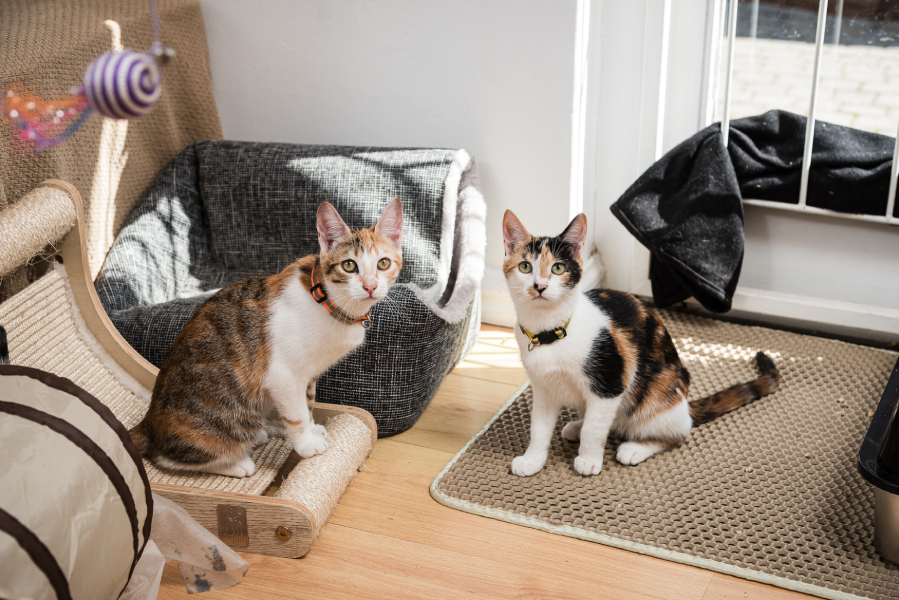
At the time, we had six cats and two dogs all abiding within our small complex home. Two of the cats were temporary residents: rescue kittens awaiting their forever homes.
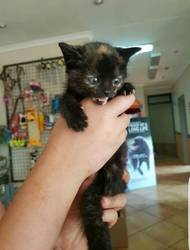
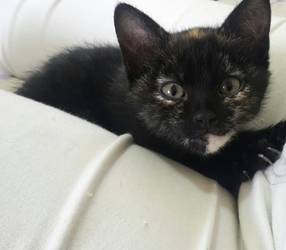
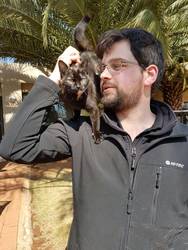
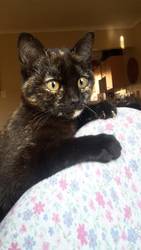
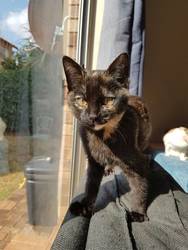
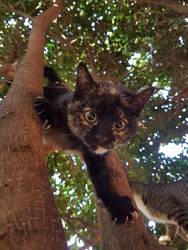
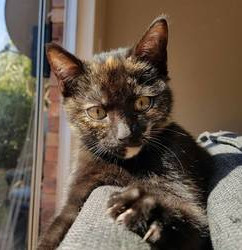
It was about two in the morning when Wim Slabber, my boyfriend, was awoken by one of the kittens, Nina retching on his chest. Tortoiseshell Nina was the smallest of the two foster kittens, with her sister Gemma almost double her size.
After painfully and helplessly watching our tiny kitten gasp, choke and hypersalivate for what felt like an eternity, she brought up her entire meal of pellets.
Now, in the veterinary profession, you witness animals suffering on a regular basis, but there’s something deeply heart-wrenching about witnessing your “own” beloved animal suffering. This was the third such incident and we knew something wasn’t quite right. After comforting our Nina and resolving to brainstorm in the morning, we turned off the lamp and attempted to sleep.
A eureka moment
No less than five minutes later, Wim flicked the lamp on, exclaiming that he knew what was wrong in a “Eureka!” moment. Rare in cats, but not uncommon, Nina’s symptoms suddenly painfully pointed towards a congenital abnormality known as Persistent Right Aortic Arch (PRAA). This condition makes it difficult or even impossible to swallow food, hence the regurgitation. Although more common in dogs, particularly German Shepherds and Irish Setters, cats can have PRAA too.
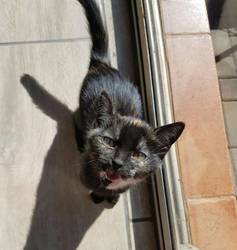
Nina was the smallest in her litter, grew very slowly and frequently regurgitated after eating. Coupled with this, she was always extremely hungry, making meal times at our house rather disastrous – there was a time where we couldn’t open the fridge without her launching herself inside.
Abnormal aortic development
We took X-rays the following morning and the results confirmed Wim’s presumptive diagnosis: Nina had PRAA.
To sum it up, Nina’s aorta (the body’s largest artery) had developed from the right side instead of the left. Whilst this abnormal development doesn’t affect the functioning of the heart, the path the aorta follows can trap other structures, most commonly the oesophagus (the tube linking the throat and stomach).
A ligament runs between the aortic arch and one of the other vessels leaving the heart. Normally, this ligament doesn’t cause any harm, but if the aorta develops from the right, the ligament effectively encircles the oesophagus, trapping it against the heart. Food cannot pass through to the stomach and it remains in the oesophagus, causing distension and a condition known as megaoesophagus – enlargement of the oesophagus.
The food cannot remain there indefinitely and the patient regurgitates. Regurgitation places the animal at risk of inhaling the undigested contents that can lead to aspiration pneumonia. Feeding the patient at an elevated height (for example, by placing their bowl on a step or chair) assists the movement of food past the dilation in the oesophagus. The condition is commonly diagnosed at weaning, when puppies or kittens make the transition from milk to solids. Liquids can pass through unobstructed and so the suckling animal copes well. PRAA can be treated surgically by transecting that ligament.
As Nina was still too small to undergo surgery, we resigned ourselves to the fact that this foster baby was going to be more than just a temporary resident.
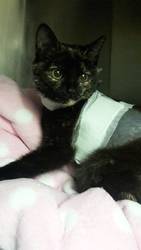
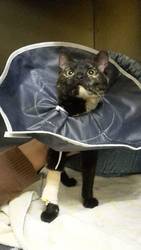
Nina in recovery
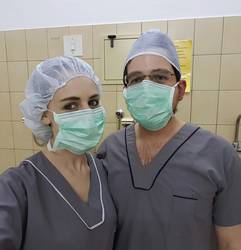
After two months of a strictly liquid diet, her surgery was scheduled at Onderstepoort. There were so many kind people who were touched by Nina’s story and who generously donated to her surgery. Wim and I were lucky enough to stand by during her surgery.
Once again, as Wim is a qualified vet and I am a vet student, one would think this whole ordeal would be very normal for us; Wim claims he didn’t feel stressed but his hand certainly felt sweaty in mine. The team of vets, nurses and students at Onderstepoort that cared for Nina were truly remarkable and I am forever grateful for the love she received whilst in their care.
After a night in ICU, Nina was discharged and we were able to take her home where she was no longer a temporary resident but a permanent resident of our home and our hearts. Often the oesophagus remains stretched following surgery and the patient is resigned to eating a semi-liquid diet lifelong. I am happy to report that Nina made a full recovery and she thoroughly enjoys her bowl of pellets… perhaps a bit too much!