Written by Amie Alden – Communications Manager: The David Sheldrick Wildlife Trust
All images provided by and remain copyrighted to The David Sheldrick Wildlife Trust
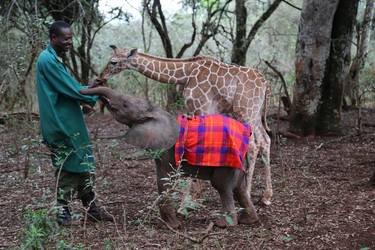
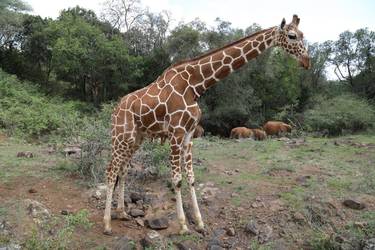
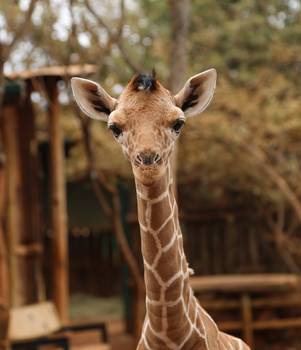
Orphaned due to human-wildlife conflict, a young Reticulated Giraffe rescued in September 2015 in Central Kenya has made some unusual friends: a herd of orphaned baby elephants.
One week old and all alone
The little giraffe was just one week old and an orphan. Alone in the wild and still dependent on its mother’s milk, no orphaned baby giraffe would have a chance of survival.
Luckily for him, he was rescued by one of the David Sheldrick Wildlife Trust (DSWT) Vet Units who work in partnership with the Kenya Wildlife Service (KWS). He was handed to a vet who knew just the place for him: a centre for orphaned infant wild animals in Nairobi National Park.
An unusual herd
Kiko has been hand-raised on specialist formula milk by trained keepers who work around the clock at the DSWT’s Elephant Orphanage caring for an unusual herd of infant wild animals who all share a common characteristic: they have been orphaned by human wildlife conflict, poaching and habitat destruction. Kiko would not be alone.
“Kiko was lucky,” says Amie, “he was spotted before he landed up on someone’s dinner plate as bush meat or was killed by predators. But his rescue just shows the devastating effect that poaching and human-wildlife conflict has on giraffe populations, causing a silent extinction. At least now, with the help of our Keepers who care for the orphans 24 hours a day, and the love of the orphaned elephants at our Nursery, he has a second chance at life in the wild.”
A tall order
Giraffes can reach 5.5 metres in height and, to accommodate his growing stature, Kiko sleeps at night in a specially built stable that’s tall enough for him to stand and remain safe from Nairobi National Park’s resident lion population.
In his early days, despite being just one week old, the DSWT’s Keepers needed to clamber high up on the stable partitions in order to get the milk bottle at the appropriate angle so that it felt natural for him to feed.
Since his rescue, Kiko has stood out as a headstrong character who loves to browse on acacia trees. He will remain in the care of the DSWT until fully grown and he spends his days wandering through the park with his keepers and herd of fellow orphans, occasionally meeting wild giraffes, ultimately learning how to live as a fully independent wild animal.
Vulnerable animals
Recent figures from the International Union for Conservation of Nature (IUCN) have shown that giraffe populations have plummeted from 155,000 in 1985 to just 97,000 in 2015, leading the ICUN to reclassify the species as “vulnerable” to extinction.
Reticulated Giraffes are a subspecies of giraffes and have been hard hit by habitat destruction, bush meat poaching and human-wildlife conflict.
To date, the DSWT Mobile Vet Units, in partnership with the Kenya Wildlife Service, have treated more than 140 giraffes for injuries ranging from snare wounds to spear and arrow wounds. Rob Brandford says, “Few people know that these iconic species are under threat and that, in localised areas, giraffes could soon be driven to extinction. Many are caught in poachers’ traps and snares and face a slow and agonising death if rescuers like our Vet Units can’t reach them.”
Brandford urges diners to reject giraffe meat if offered as a delicacy in global restaurants, and to consider donating towards Kiko’s care through the DSWT’s foster programme.
To find out more about The David Sheldrick Wildlife Trust, visit www.sheldrickwildlifetrust.org and to learn more about The David Sheldrick Wildlife Trust’s Foster Programme, visit www.thedswt.org/foster